Thursday, April 9, 2020

GLOBAL MARITIME REGULATORY SYSTEM

Maritime studies is an interdisciplinary academic field that uses liberal arts as the foundation for exploring humankind's relationship with waterways and watersheds. Incorporating history, literature, poetry, and film. Maritime studies covers a broader scope than traditional maritime history or seamanship. Some of the institutions providing maritime studies combine a broad grounding in technical and scientific coursework with the study of courses in arts and humanities. While maritime academies frequently prepare cadets for careers in the merchant marine, maritime studies programs prepare students for a variety of careers in the civilian maritime industrial and service sectors. However the maritime field is governed and under control by their own regulatory system. These systems must be followed and by not doing so is against the law of the sea and actions will be taken. These are some global maritime regulatory system.

SOLAS

The International Convention for the Safety of Life at Sea (SOLAS) is an international maritime treaty which sets minimum safety standards in the construction, equipment and operation of merchant ships. The convention requires signatory flag states to ensure that ships flagged by them comply with at least these standards. The current version of SOLAS is the 1974 version, known as SOLAS 1974, which came into force on 25 May 1980. As of November 2018, SOLAS 1974 had 164 contracting states, which flag about 99% of merchant ships around the world in terms of gross tonnage. SOLAS 1974 requires flag states to ensure that ships flagged by them comply with the minimum safety standards in the construction, equipment and operation of merchant ships. The treaty includes articles setting out general obligations, followed by an annexe divided into twelve chapters, two new chapters were added in 2016 and 2017. Of these, chapter five (often called 'SOLAS V') is the only one that applies to all vessels on the sea, including private yachts and small craft on local trips as well as to commercial vessels on international passages. Many countries have turned these international requirements into national laws so that anybody on the sea who is in breach of SOLAS V requirements may find themselves subject to legal proceedings.

( Source : Google Images )

MARPOL

The International Convention for the Prevention of Pollution from Ships, 1973 as modified by the Protocol of 1978 (MARPOL 73/78, MARPOL is short for maritime pollution and 73/78 short for the years 1973 and 1978) is one of the most important international marine environmental conventions. It was developed by the International Maritime Organization with an objective to minimize pollution of the oceans and seas, including dumping, oil and air pollution. The original MARPOL was signed on 17 February 1973, but did not come into force at the signing date. The current convention is a combination of 1973 Convention and the 1978 Protocol, which entered into force on 2 October 1983. As of January 2018, 156 states are parties to the convention, being flag states of 99.42% of the world's shipping tonnage. All ships flagged under countries that are signatories to MARPOL are subject to its requirements, regardless of where they sail and member nations are responsible for vessels registered on their national ship registry. MARPOL is divided into Annexes according to various categories of pollutants, each of which deals with the regulation of a particular group of ship emissions.
ANNEX I - Prevention of pollution by oil & oily water
ANNEX II - Control of pollution by noxious liquid substances in bulk
ANNEX III - Prevention of pollution by harmful substances carried by sea in packaged form
ANNEX IV - Pollution by sewage from ships
ANNEX V - Pollution by garbage from ships
ANNEX VI - Prevention of air pollution from ships

( Source : Google Images )

STCW

International Convention on Standards of Training, Certification and Watchkeeping for Seafarers (STCW), 1978 sets minimum qualification standards for masters, officers and watch personnel on seagoing merchant ships and large yachts.[2] STCW was adopted in 1978 by conference at the International Maritime Organization (IMO) in London, and entered into force in 1984. The Convention was significantly amended in 1995. The 1978 STCW Convention was the first to establish minimum basic requirements on training, certification and watchkeeping for seafarers on an international level. Previously the minimum standards of training, certification and watchkeeping of officers and ratings were established by individual governments, usually without reference to practices in other countries. As a result, minimum standards and procedures varied widely, even though shipping is extremely international by nature. The Convention prescribes minimum standards relating to training, certification and watchkeeping for seafarers which countries are obliged to meet or exceed.

( Source : Google Images )

MLC

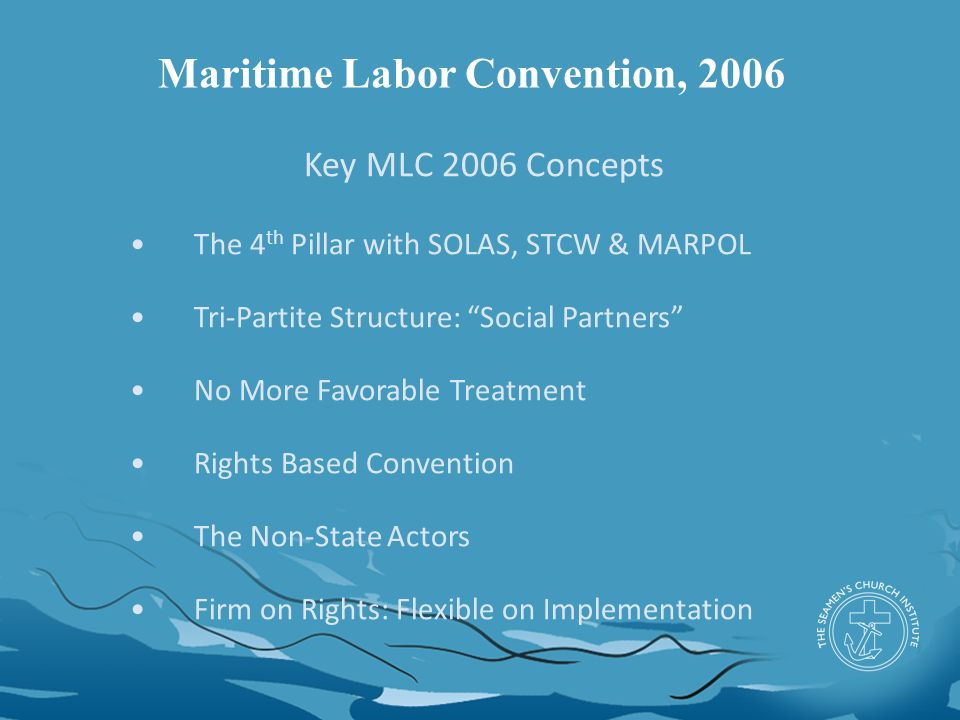
The Maritime Labour Convention (MLC) is an International Labour Organization convention, number 186, established in 2006 as the fourth pillar of international maritime law and embodies "all up-to-date standards of existing international maritime labour Conventions and Recommendations, as well as the fundamental principles to be found in other international labour Conventions". The other "pillars are the SOLAS, STCW and MARPOL. The treaties applies to all ships entering the harbours of parties to the treaty (port states), as well as to all states flying the flag of state party (flag states, as of 2019: over 90 per cent). The convention entered into force on 20 August 2013, one year after registering 30 ratifications of countries representing over 33 per cent of the world gross tonnage of ships. Already after five ratifications the ratifying countries (Bahamas, Norway, Liberia, Marshall Islands, and Panama) represented over 43 percent of the gross world tonnage (which is over 33 per cent; the second requirement for entry into force). As of September 2019, the convention has been ratified by 94 states representing over 94 per cent of global shipping.

( Source : Google Images )

- THANK YOU -

Wednesday, April 8, 2020

GMRS

GLOBAL MARITIME REGULATORY SYSTEM

A] SOLAS
The International Convention for the Safety of Life at Sea (SOLAS) is an international maritime treaty which sets minimum safety standards in the construction, equipment and operation of merchant ships. The convention requires signatory flag states to ensure that ships flagged by them comply with at least these standards.
The current version of SOLAS is the 1974 version, known as SOLAS 1974, which came into force on 25 May 1980. As of November 2018, SOLAS 1974 had 164 contracting states, which flag about 99% of merchant ships around the world in terms of gross tonnage.
SOLAS 1974 requires flag states to ensure that ships flagged by them comply with the minimum safety standards in the construction, equipment and operation of merchant ships. The treaty includes articles setting out general obligations, etc., followed by an annexe divided into twelve chapters, two new chapters were added in 2016 and 2017. Of these, chapter five (often called 'SOLAS V') is the only one that applies to all vessels on the sea, including private yachts and small craft on local trips as well as to commercial vessels on international passages. Many countries have turned these international requirements into national laws so that anybody on the sea who is in breach of SOLAS V requirements may find themselves subject to legal proceedings.
Google Image

 B)  MARPOL
MARPOL is the main international convention aimed at the prevention of pollution from ships caused by operational or accidental causes. It was adopted at the International Maritime Organization (IMO) in 1973. The Protocol of 1978 was adopted in response to a number of tanker accidents in 1976–1977. The 1978 Protocol was absorbed into the parent Convention and the combined instrument entered into force in 1983. In 1997, a Protocol was adopted to amend the Convention and a new Annex VI was added, which came into force in May 2005. The technical requirements of MARPOL are included in six separate Annexes:
· Annex I—Regulations for the Prevention of Pollution by Oil
· Annex II—Regulations for the Control of Pollution by Noxious Liquid Substances in Bulk
· Annex III—Prevention of Pollution by Harmful Substances Carried in Sea in Packaged Form
· Annex IV—Prevention of Pollution by Sewage from Ships
· Annex V—Prevention of Pollution by Garbage from Ships
· Annex VI—Prevention of Air Pollution from Ships

Google Image

C) STCW

STCW stands for Standards of Training, Certification, and Watchkeeping. The reason for them is, among other things, to keep you, a seafarer, safe while at sea.
The standards were first adopted in 1978; to come into force they had to be ratified by 25 nations, with the condition that these nations had at least 25% of the gross world tonnage of ships 100 gross tons or more. The standards came into effect in April 1984 when the condition was met. Amendments were made in 1995 that came into force in February 1997. Further amendments were adopted in 2010 and came into force in January 2012. As of 2018, 164 nations, representing 99.2 percent of world shipping tonnage, have ratified the STCW.
The standards are enforced by the International Maritime Organization (IMO), which was created in 1948 and came into force in 1958. In addition to enforcing the STCW, the IMO has created and/or oversees numerous international agreements concerning the seas, including the International Convention for the Prevention of Pollution from Ships (MARPOL), the International Convention for the Safety of Life at Sea (SOLAS), the International Mobile Satellite Organization (IMSO), and the Convention for the Suppression of Unlawful Acts (SUA) Against the Safety of Maritime Navigation.
Google Image

D) MLC
The Maritime Labour Convention 2006 (MLC) is an international agreement of the International Labour Organisation (‘ILO’) which sets out seafarers’ rights to decent conditions of work.  It is sometimes called the ‘Seafarers’ Bill of Rights’.  It applies to all seafarers, including those with jobs in hotel and other passenger services on cruise ships and commercial yachts, In 2013 the MLC became binding law for 30 countries.
Google Image

Tuesday, April 7, 2020

Global Maritime Regulatory System


So guys good evening. Today i am going to explain to all of you about Global Maritime Regulatory System. This system consists of four pillars which is International Convention on Standards of Training, Certification and Watchkeeping for Seafarers (STCW),International Convention for the Safety of Life at Sea (SOLAS),International Convention for the Safety of Life at Sea (SOLAS),Maritime Labour Convention (MLC). So these are some explanation on the 4 pillars that make one big system that controls or make business in maritime industry run smoothly.

International Convention on Standards of Training, Certification and Watchkeeping for Seafarers (STCW)

The 1978 STCW Convention was the first to establish minimum basic requirements on training, certification and watchkeeping for seafarers on an international level. Previously the minimum standards of training, certification and watchkeeping of officers and ratings were established by individual governments, usually without reference to practices in other countries. As a result, minimum standards and procedures varied widely, even though shipping is extremely international by nature.

The Convention prescribes minimum standards relating to training, certification and watchkeeping for seafarers which countries are obliged to meet or exceed.

The four basic STCW courses are as follows:
Personal Safety and Social Responsibilities – This is a classroom-based course that focuses on teaching the essentials of basic safety.
BASIC Fire Prevention and Fire Fighting – This firefighting course covers both practical and theoretical situations that are taught by professional firefighters.
Personal Survival Techniques – A theory and practical course, you will be taught how to abandon ship using life rafts and also how to don life jackets correctly.
Elementary First Aid – A theory and practical course, during this session you will be taught vital basic 1st aid and life savings skills.
Proficiency in Security Awareness - This course is not normally part of basic STCW week; however it is a required course that you must complete prior going to sea. Normally, if you book onto the 4 mandatory courses listed above, your course supplier will include this one for free. It's a half day course that can easily be slotted into your training week, and is designed to explain how security systems work on board.
                                                   IMO's STCW Training for Seafarers in Timor Leste - mfame.guru

International Convention for the Safety of Life at Sea (SOLAS)


The International Convention for the Safety of Life at Sea (SOLAS) is an international maritime treaty which sets minimum safety standards in the construction, equipment and operation of merchant ships. The convention requires signatory flag states to ensure that ships flagged by them comply with at least these standards.
The current version of SOLAS is the 1974 version, known as SOLAS 1974, which came into force on 25 May 1980. As of November 2018, SOLAS 1974 had 164 contracting states,which flag about 99% of merchant ships around the world in terms of gross tonnage.
SOLAS in its successive forms is generally regarded as the most important of all international treaties concerning the safety of merchant ships.
                                                              SOLAS XI-2 ISPS Code
International Convention for the Prevention of Pollution from Ships (MARPOL)

The International Convention for the Prevention of Pollution from Ships (MARPOL) is the main international convention covering prevention of pollution of the marine environment by ships from operational or accidental causes.
The MARPOL Convention was adopted on 2 November 1973 at IMO. The Protocol of 1978 was adopted in response to a spate of tanker accidents in 1976-1977. As the 1973 MARPOL Convention had not yet entered into force, the 1978 MARPOL Protocol absorbed the parent Convention. The combined instrument entered into force on 2 October 1983. In 1997, a Protocol was adopted to amend the Convention and a new Annex VI was added which entered into force on 19 May 2005. MARPOL has been updated by amendments through the years.

The Convention includes regulations aimed at preventing and minimizing pollution from ships - both accidental pollution and that from routine operations - and currently includes six technical Annexes. Special Areas with strict controls on operational discharges are included in most Annexes.

These are the Annexes in the convention:
-Annex I Regulations for the Prevention of Pollution by Oil (entered into force 2 October 1983)
-Annex II Regulations for the Control of Pollution by Noxious Liquid Substances in Bulk (entered into force 2 October 1983)
-Annex III Prevention of Pollution by Harmful Substances Carried by Sea in Packaged Form (entered into force 1 July 1992)
-Annex IV Prevention of Pollution by Sewage from Ships (entered into force 27 September 2003)
-Annex V Prevention of Pollution by Garbage from Ships (entered into force 31 December 1988)
-Annex VI Prevention of Air Pollution from Ships (entered into force 19 May 2005)
                                               MARPOL. - ppt download

Maritime Labour Convention (MLC)
The Maritime Labour Convention (MLC) is an International Labour Organization convention, number 186, established in 2006 as the fourth pillar of international maritime law and embodies "all up-to-date standards of existing international maritime labour Conventions and Recommendations, as well as the fundamental principles to be found in other international labour Conventions". The other "pillars are the SOLAS, STCW and MARPOL. The treaties applies to all ships entering the harbours of parties to the treaty (port states), as well as to all states flying the flag of state party (flag states, as of 2019: over 90 per cent).
                                                 Maritime Labour Convention, ppt download

Sunday, April 5, 2020

Facing Difficulties

In this post, Maam Hanim asked us to share our own experience when reacting to difficulties. So as far as I concerned, there are many difficulties I faced in the past. But today, I am going to share with you the difficulties that all of us are currently facing together. However, our reaction might differ so lets start.

source : Google image

COVID-19

I think we all know what it is..so how I am reacting to it??

1. Concern about hygiene all the time
2. Always wash hand properly especially after visit the market
3. Stay healthy by doing home workout
4. Stay at home and don't go out unless emergency/necessary
5. Keep positive mindset with my loved ones
6. Prepare for the worst
7. Don't listen or share fake news
8. Develop new hobby
9. Reduce waste especially food waste
10. Follow MCO regulations

Well, there are many more but this is the top 10 I guess. Stay safe and Stay at Home :)

source : Google image

source : Google image

source : Google image


Saturday, April 4, 2020

Global Maritime Regulatory System

Have you heard about Global Maritime Regulatory System. Let me explain to you..

1. Safety of Life at Sea (SOLAS)

In 1914, the first version of SOLAS was accepted as a response of the sinking of the RMS Titanic. It prescribed numbers of lifeboats and other emergency equipment along with safety procedures, including continuous radio watches. The 1914 treaty never entered into force due to the outbreak of World War I. New versions were adopted in 1929, 1948, 1960, 1974, 1988, 2011, 2015 and 2016.

SOLAS Regulation XI-1/7 took effect on October 1st, 2016. This regulation requires the carriage of an appropriate atmosphere testing instrument or instruments for enclosed space entry. These portable testing devices are not part of somebody’s personal protective safety equipment (PPE), but a part of the vessels equipment. They will be used to test enclosed spaces from the outside to make sure that they are safe to enter and will cover, as a minimum, the following gases: oxygen, flammable gases or vapours, carbon monoxide and hydrogen sulphide. Suitable means should be provided to calibrate them.


source : Google image

2. International Convention for the Prevention of Pollution from Ships (MARPOL)

The International Convention for the Prevention of Pollution from Ships (MARPOL) is the main international convention covering prevention of pollution of the marine environment by ships from operational or accidental causes.

The MARPOL Convention was adopted on 2 November 1973 at IMO. The Protocol of 1978 was adopted in response to a spate of tanker accidents in 1976-1977. As the 1973 MARPOL Convention had not yet entered into force, the 1978 MARPOL Protocol absorbed the parent Convention. The combined instrument entered into force on 2 October 1983. In 1997, a Protocol was adopted to amend the Convention and a new Annex VI was added which entered into force on 19 May 2005. MARPOL has been updated by amendments through the years.

The Convention includes regulations aimed at preventing and minimizing pollution from ships - both accidental pollution and that from routine operations - and currently includes six technical Annexes. Special Areas with strict controls on operational discharges are included in most Annexes.

source : Google image

3. STCW

source : Google image


What is STCW and who needs it?

STCW stands for Standards of Training, Certification and Watchkeeping. It is a worldwide convention that ensures a lateral standard of training is achieved across all countries in the world. So for instance, if you're a Captain from Europe or America, you will have to undergo similar training in accordance with the STCW convention.

Who is STCW for?
Anyone wishing to work on commercial vessels that are over 24 metres long will have to obtain STCW qualifications/courses before they seek employment. The type of courses/qualifications you'll need will greatly depend on the position you're applying for and the post you'll be assigned to once you're on-board.

At the very minimum, you will need to obtain STCW Basic Safety Courses in order to apply to work on a ship. These courses can usually be completed within a week - during one block booking - at a designated STCW training centre.

The four basic STCW courses are as follows:

Personal Safety and Social Responsibilities – This is a classroom-based course that focuses on teaching the essentials of basic safety.
BASIC Fire Prevention and Fire Fighting – This firefighting course covers both practical and theoretical situations that are taught by professional firefighters.
Personal Survival Techniques – A theory and practical course, you will be taught how to abandon ship using life rafts and also how to don life jackets correctly.
Elementary First Aid – A theory and practical course, during this session you will be taught vital basic 1st aid and life savings skills.
Proficiency in Security Awareness - This course is not normally part of basic STCW week; however it is a required course that you must complete prior going to sea. Normally, if you book onto the 4 mandatory courses listed above, your course supplier will include this one for free. It's a half day course that can easily be slotted into your training week, and is designed to explain how security systems work on board.


4. Maritime Labour Convention, 2006

Maritime Labour Convention (MLC), according to the ILO or International Labour Organisation, provides a broad perspective to the seafarer’s rights and fortification at work. The maritime regulation will finally enter into force on August 20th, 2013. Nearly 1.2 million seafarers will be affected by the terms and conditions of this human rights act, which will lay down a set of regulations for protection at work, living conditions, employment, health, social security and similar related issues.

On the basis of Maritime Labour Convention (MLC), the Seafarer’s Employment Contracts will be implemented and mandated against nullifying the present employment contracts. MLC will be similar to the other statutory certifications such as ISM and ISPS onboard ships and the certificate will have 5 years of validity with interim, initial and intermediate surveys. It is imperative for all seafarers to understand the importance of Maritime Labour Convention (MLC), 2006.
 Under MLC, 2006, the ship owners are required to submit a DMLC or Declaration of Maritime Labour Compliance to their respective flag states which form a party to the convention. The flag states will accordingly issue the MLC Certificate to the fleet flying their flag following, surveys, inspections, paperwork and approvals. The certificate would be then required to be posted at a conspicuous position onboard.

Contents of MLC,2006 


source : Google image